
On this page
- Strengthen the man who has to do the parenting.
- Black fatherhood deserves depth, dignity, and room to grow.
- Twelve weeks.Conversations with a purpose.
- Dr. Derek Collins
- Give each conversation a follow-through.
- Bring the program to your fathers. Build the agreement around your organization.
- Make a confident curriculum decision.
- Fatherhood curriculum & licensing FAQs
- Your fathers have a future worth investing in.
THE DIVERSION CENTER CURRICULUM · TRAINING · LICENSING
Real talk for men who show up
Created by Dr. Derek Collins PhD · CADC-II · MATS · SAP
Help fathers turn the conversations they avoid into the commitments they keep. A 12-week program by Dr. Derek Collins, built around accountability, emotional growth, meaningful presence, and legacy.
For organizations serving Black fathers and diverse communities of dads.
Discuss curriculum licensing Explore the 12 sessions
Workbooks · Facilitator training · Single-site and multi-site licensing
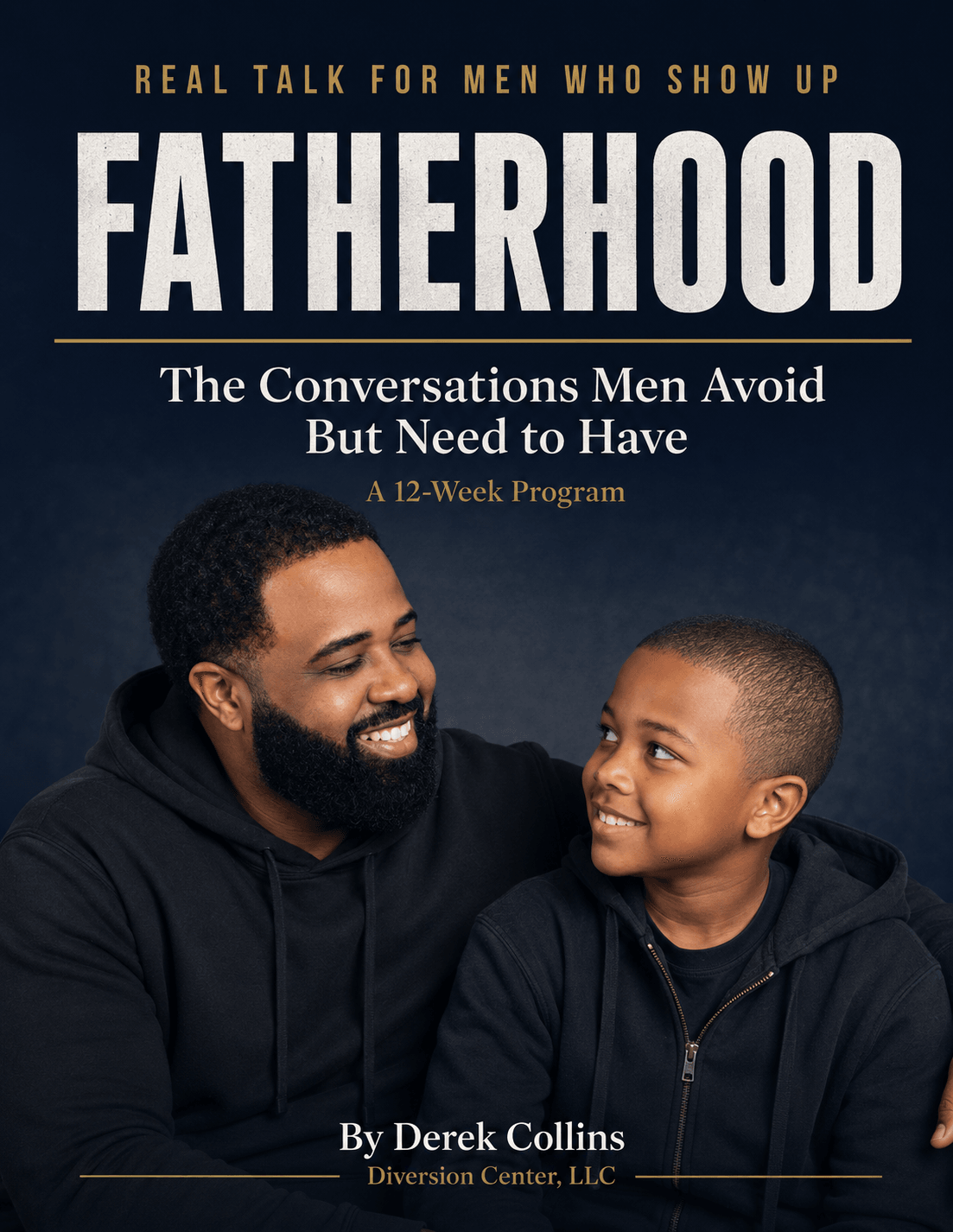
The conversations men avoid. The work families deserve.
12 weeks A structured learning journey
90 minutes Per core session
176 pages Participant workbook
Real practice Reflection, action, and tracking
The program
Strengthen the man who has to do the parenting.
Being a father asks a man to manage his emotions, keep his word, build trust, and show up when life gets hard. Give him a place to practice.
Fatherhood: The Conversations Men Avoid But Need to Have is a structured fatherhood curriculum developed by Dr. Derek Collins and offered through The Diversion Center.
Across twelve sessions, fathers examine the experiences, beliefs, habits, and decisions that influence how they parent. They move from discussion to written reflection, practical exercises, and specific actions between sessions.
Organizations can request participant workbooks, fatherhood facilitator training, and curriculum licensing for a single program or a network of sites.
Culture. Connection. Possibility.
Black fatherhood deserves depth, dignity, and room to grow.
A father is more than a statistic, a case number, or a stereotype. His story includes strengths, relationships, ambition, and the legacy he wants to leave.
01 / SEE THE WHOLE MAN
Start with his experience.
Make room for conversations about identity, the father he needed, emotional expression, and the expectations he carries. Invite his perspective instead of assuming his story.
02 / CONNECT TO HIS CHILDREN
Make presence practical.
Help fathers plan words of encouragement, undistracted attention, and small everyday moments that make connection a deliberate part of family life.
03 / BUILD WHAT COMES NEXT
Turn reflection into action.
Link accountability, health, financial habits, and personal goals to the father he wants his children to know. Give each week’s conversation a next step.
Designed for culturally responsive facilitation with Black fathers and adaptable to diverse groups. Black fathers have varied experiences; justice-system involvement is one possible context, not a definition of Black fatherhood.
Inside the participant workbook
Twelve weeks.Conversations with a purpose.
The core sequence follows the workbook exactly. Each session is planned for 90 minutes, for 18 hours of core session time.
- 01 What It Really Means to Be a Man Accountability, leadership, values, and the principles that protect what matters. Participant workbook · page 12
- 02 The Father You Needed Explore the fathering you experienced and the kind of father you choose to become. Participant workbook · page 25
- 03 Mastering the Fire Recognize anger patterns and practice responding without hurting the people you love. Participant workbook · page 40
- 04 The Stuff We Don’t Say Open conversations about emotional wellness, grief, stress, substance use, and asking for help. Participant workbook · page 55
- 05 Building the Man Examine self-talk, recognize strengths, and build a more grounded sense of self-worth. Participant workbook · page 68
- 06 Discipline: The Master Skill Practice consistency, interrupt impulsive habits, and follow through on commitments. Participant workbook · page 83
- 07 Getting Older, Real Talk Connect health, aging, and hard-earned wisdom to being there for your family. Participant workbook · page 96
- 08 Being an Intentional, Present Father Plan meaningful attention, encouragement, and everyday connection with your children. Participant workbook · page 108
- 09 Provider with a Purpose Build a simple money plan, identify spending leaks, and model financial responsibility. Participant workbook · page 120
- 10 Weathering the Storms Practice gratitude, accountability, and constructive responses to life’s setbacks. Participant workbook · page 132
- 11 Letting Go Examine habits, relationships, and old hurt; identify a concrete next step toward change. Participant workbook · page 144
- 12 Design Your Life Create a vision for fatherhood and plan both everyday moments and shared experiences. Participant workbook · page 157
PLUS: The Respect Factor
A bonus session on the behaviors that build respect with your children—and with yourself.
Session titles, page references, and duration: Participant Edition, contents pages 2–5 and session opening pages. Bonus session: pages 171–173.
Meet the author & trainer
Dr. Derek Collins
PhD CADC-II MATS SAP
Your facilitator training should reflect what happens in the room.
Dr. Collins brings direct work with people navigating incarceration, diversion, reentry, and court-mandated programs to his approach to fatherhood education.
That experience matters when a conversation about parenting also becomes a conversation about anger, substance use, family separation, shame, or starting over.
Read about Dr. Collins and The Diversion Center
- A practitioner who works with the population His current work with justice-involved clients connects the curriculum to the difficult conversations, competing responsibilities, and opportunities for change that facilitators encounter.
- A trainer of helping professionals Through The Diversion Center, Dr. Collins trains counselors, therapists, social workers, and facilitators in providing court-mandated classes and diversion programs.
- A founder and curriculum author He founded the National Association of Court Approved Treatment Providers (NACATP) and develops practical educational resources for professionals and the people they serve.
Ask about training with Dr. Collins
From the group room to everyday life
Give each conversation a follow-through.
The workbook gives fathers a repeated rhythm: check in, explore the topic, reflect, choose an action, and track practice.
- Start with reflection. Use the Week 1 self-check to help fathers identify the areas they want to work on.
- Practice between sessions. Use real-life scenarios, written exercises, and weekly action trackers to connect discussion to daily behavior.
- Revisit the starting point. Compare the Week 12 self-check with the same ten statements from Week 1 and identify continued goals.
For organizations working where fatherhood meets real life
Explore implementation in responsible fatherhood programs, community organizations, family resource centers, behavioral health programs, and reentry services.
For fathers affected by incarceration or family separation, discuss how delivery can support accountability and connection while respecting the setting and family circumstances.
Fatherhood initiatives Community nonprofits Reentry & diversion Corrections Probation & parole Family services Faith-based organizations
A clear distinction about evidence
The workbook cites established research and concepts. Its self-checks support reflection; they are not validated measures or proof of program effectiveness. Organizations can request current evaluation information and determine what additional measurement their implementation needs.
Purchasing & organizational implementation
Bring the program to your fathers. Build the agreement around your organization.
Start with the materials your program needs, prepare your facilitators, or discuss a broader curriculum license. Request an itemized proposal based on your scope.
PARTICIPANT MATERIALS
Workbook purchases
For organizations equipping a cohort or purchasing materials for ongoing fatherhood programming.
- Share your anticipated quantity
- Request current format and delivery options
- Discuss volume pricing
Request a workbook quote
FACILITATOR DEVELOPMENT
Training with Dr. Collins
For organizations preparing staff to facilitate the curriculum and its more sensitive conversations.
- Discuss staff training needs
- Confirm training format and materials
- Ask about certification options
Discuss facilitator training
AGENCY & NETWORK LICENSING
One site. Multiple sites.Systemwide possibilities.
For organizations seeking defined curriculum rights across a program, agency, or service network.
- Define sites and participant volume
- Scope staff preparation and support
- Specify permitted use and license term
Request a licensing proposal
Pricing, availability, training deliverables, support, and certification terms are confirmed in the proposal. Reproduction, redistribution, customization, and branding rights require written authorization in the license agreement.
A practical buying conversation
Make a confident curriculum decision.
Give your program team and purchasing team the same clear picture of what you need.
- Review program fit. Request curriculum review access and discuss your fathers, delivery setting, and program goals.
- Define the scope. Share your sites, annual participant volume, number of facilitators, launch timeline, and purchasing requirements.
- Request an itemized proposal. Confirm materials, training, license rights, delivery, and any implementation support before committing.
Questions from program leaders
Fatherhood curriculum & licensing FAQs
It is a 12-week fatherhood curriculum by Dr. Derek Collins of The Diversion Center. The 176-page participant workbook contains twelve 90-minute sessions, guided exercises, real-life scenarios, weekly action trackers, beginning and ending self-checks, and a bonus session called The Respect Factor.
Yes. The Diversion Center positions this curriculum for culturally responsive work with Black fathers. It creates space for conversations about identity, family history, emotional expression, responsibility, and legacy. Facilitators should invite each father’s own experience rather than assume a single story about Black men or Black families.
No. The curriculum can also support groups of fathers from other racial, cultural, and socioeconomic backgrounds. Organizations should review the language, examples, and delivery approach for their participants.
Compare participant fit, the actual session content, facilitator preparation, implementation requirements, licensing rights, cost, and the quality of program-specific outcome evidence. Ask to review the materials before selecting a program. The best fit depends on your fathers, your setting, and your organization’s requirements.
Organizations serving fathers affected by incarceration, diversion, probation, parole, and reentry can discuss implementation with The Diversion Center. The curriculum addresses anger, accountability, intentional presence, money habits, and future planning. Delivery must fit the setting, family safety needs, and any applicable contact restrictions.
Yes. Contact The Diversion Center about facilitator training and organizational staff training. Request a proposal specifying training format, number of staff, materials, implementation support, and any available certification option. Certification scope and requirements should be confirmed in writing.
Yes. Request a quote for participant workbooks or discuss single-site, multi-site, and systemwide curriculum licensing. The written agreement defines the materials, term, sites, participant volume, training, and any reproduction, distribution, or branding rights.
The workbook draws on practitioner experience and cites established research and concepts. That is different from demonstrating this specific program’s effectiveness through an independent evaluation. The included self-checks are participant reflection tools, not validated outcome measures. Ask about current program-specific evaluation evidence if your organization requires it.
Discuss the curriculum’s fit with your program and review it against your award requirements. Its focus includes father engagement, relationships, accountability, and financial habits. Purchasing this curriculum does not itself establish grant eligibility or satisfy every funder’s evidence, service, or reporting requirements.
Email dcollins@thediversioncenter.com or call 404-503-8069. Include your organization, population served, number of sites, estimated fathers served annually, staff training needs, and intended launch date.
Start the conversation
Your fathers have a future worth investing in.
Bring a structured fatherhood curriculum to the people your organization serves. Contact Dr. Derek Collins to discuss workbook purchases, facilitator training, or institutional licensing.
Tell us the scale of your program and what you need to accomplish. Ask for a curriculum review and a proposal tailored to your organization.
Strengthen the man. Strengthen the father. Strengthen the family.
© 2026 Diversion Center, LLC · Fatherhood curriculum by Dr. Derek Collins