
DOT SAP Timeline: How Long the Return-to-Duty Process Takes
DOT SAP Timeline: How Long the Return-to-Duty Process Takes

The DOT SAP timeline has no fixed length, because the Substance Abuse Professional (SAP) sets it after your first evaluation. The evaluation itself can be scheduled quickly. The education or treatment the SAP recommends decides most of the calendar, and follow-up testing then runs for a year or more. At The Diversion Center, we offer same-day and expedited SAP appointments, including live virtual sessions over Zoom, so you can start the clock right away. A SAP evaluation at our practice is priced at $400.
TL;DR
- You cannot perform safety-sensitive DOT duties until you finish the SAP evaluation, referral, and education or treatment process, per 49 CFR 40.285.
- Nobody can honestly promise a total timeline before the first evaluation: federal guidance says estimated return-to-duty timelines should not be given beforehand.
- After you return, the SAP’s plan requires at least six unannounced tests in the first 12 months, and testing can continue for up to 60 months.
- The part you control is speed at the start: choose a SAP, get the initial evaluation done, and begin the recommended program quickly.
Table of Contents
- Why the timeline differs for every driver
- The steps, in order
- Timeline at a glance
- How long the violation stays on your record
- What helps you move faster
- Our perspective
- Start your evaluation
- FAQ
- Sources
Why the timeline differs for every driver
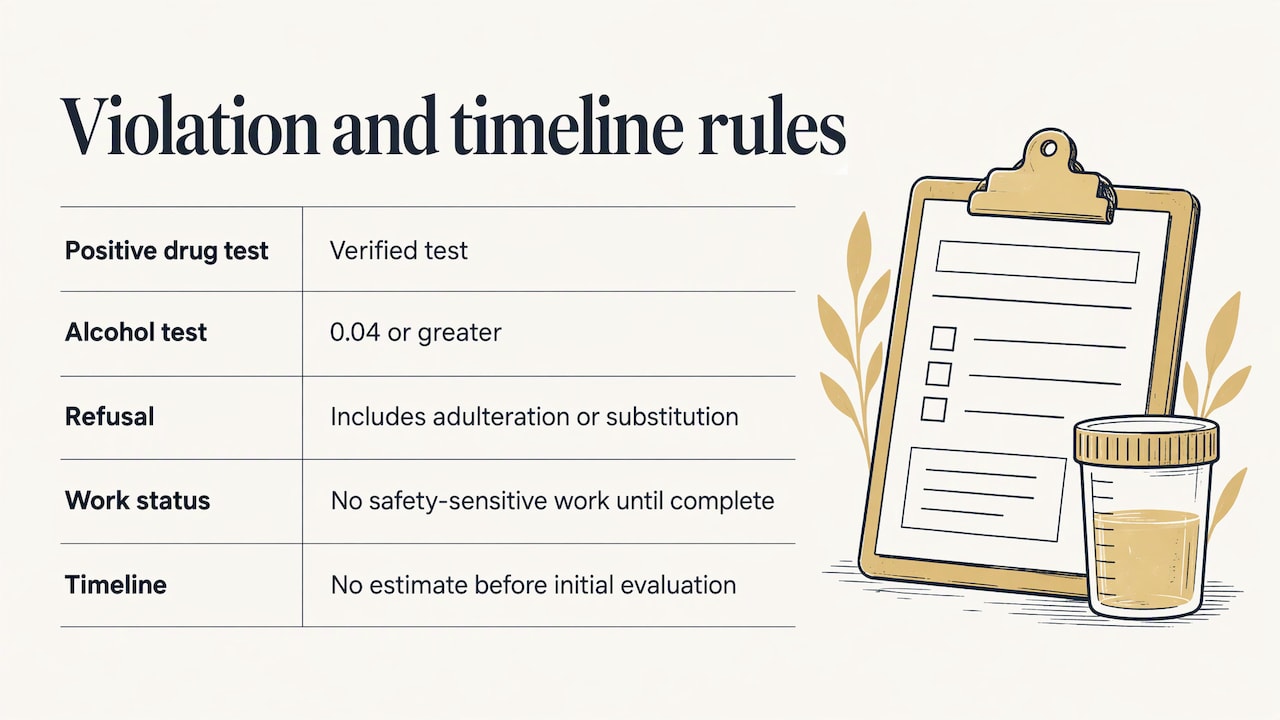
The SAP reviews your situation in a comprehensive initial evaluation, then recommends education, treatment, or both. Someone who needs a short education course moves through the process differently than someone who needs a longer treatment program. That is why the U.S. DOT’s guidance for SAPs says it is never appropriate to give an employee an estimated return-to-duty timeline before the initial evaluation.
A violation, under the federal rules, means a verified positive drug test, an alcohol test of 0.04 or greater, or a refusal to test, including adulteration or substitution (eCFR, 49 CFR Part 40 Subpart O). Any of these removes you from safety-sensitive work for every employer until the process is complete.
The steps, in order
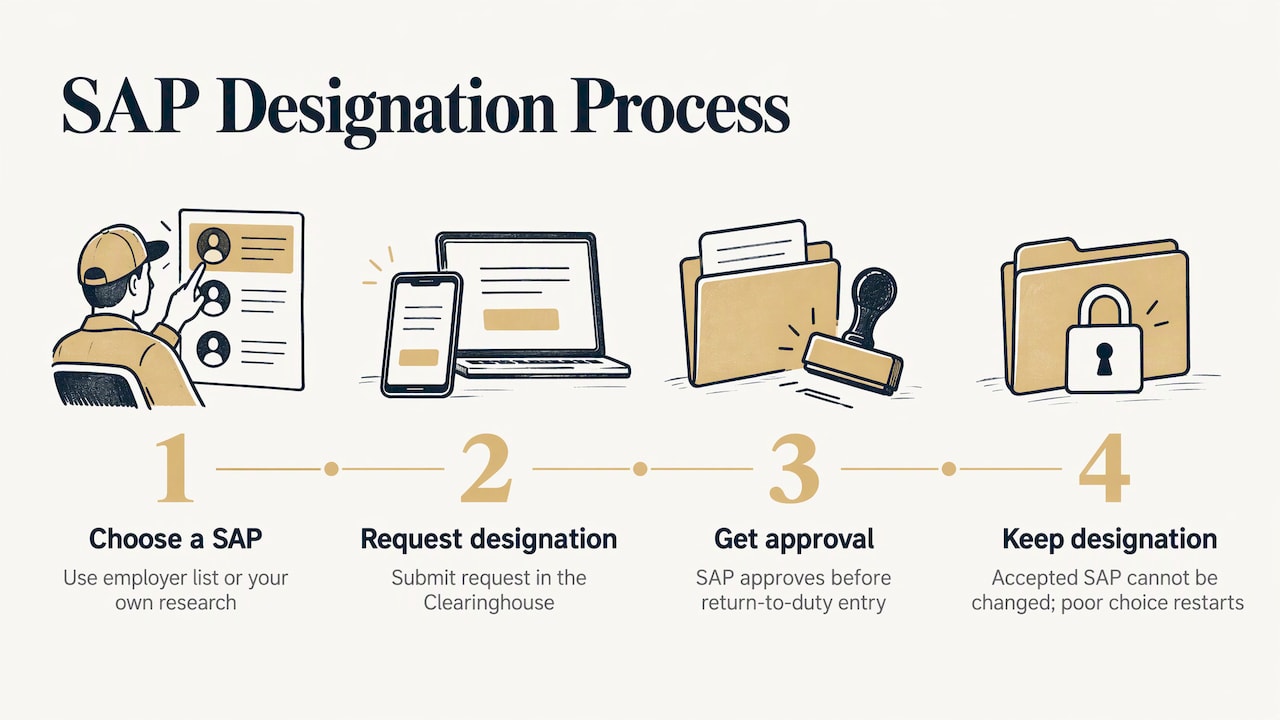
Step 1: Choose a SAP and designate them
If you drive under FMCSA rules, you pick the SAP, either from your employer’s list or by your own research, and send a designation request in the Clearinghouse. The SAP must approve it before entering your return-to-duty information, and once accepted you cannot designate a different SAP. Choosing carefully on day one avoids a restart.
This is the step where a responsive provider saves days. Our team answers the phone, and we can usually schedule the evaluation quickly. Our guide to how the Clearinghouse and SAP work together walks through the designation screens.
Step 2: The initial evaluation
The SAP conducts a clinical assessment, which may be done in person or remotely, at the SAP’s discretion under 49 CFR 40.291. The evaluation covers topics such as legal history, financial status, and psychiatric history (FTA 2023 conference presentation). The SAP must report the date of the initial assessment in the Clearinghouse by the close of the next business day (FMCSA Clearinghouse FAQ).
Because we offer live virtual SAP evaluations, a driver without a vehicle or with a day job can complete this step from a phone or laptop. See our virtual SAP evaluation page for how that works.
Step 3: Education or treatment
The SAP refers you to education, treatment, or both, and sends the recommendations to your employer’s Designated Employer Representative (DER). This is the longest and least predictable stretch. Its length depends on what the SAP recommends, and you complete it with the provider the SAP names. Finishing the program steadily, without gaps, is the single biggest factor you control.
Step 4: The follow-up evaluation
After you complete the recommendations, the SAP confers with or gets documentation from the program professionals and conducts a clinical interview (49 CFR 40.301). If you demonstrated successful compliance, the SAP reports in writing to the DER. If not, your employer must not return you to safety-sensitive duty, and the SAP may conduct additional follow-up evaluations.
The SAP must also report the date you are determined eligible for return-to-duty testing by the close of the next business day (FMCSA Clearinghouse FAQ).
Step 5: The return-to-duty test
If your employer chooses to return you to duty, you must pass a return-to-duty test with a negative drug result and/or an alcohol concentration below 0.02. Employers are not required to rehire you, so keep the DER informed throughout. Our overview of every step back to work covers what to say to your employer at this point.
Step 6: Follow-up testing
The SAP builds a follow-up testing plan requiring at least six unannounced tests in the first 12 months, with possible testing in the following 48 months (49 CFR Part 40 Subpart O). The FMCSA describes plans covering one to five years. You are back at work during this phase, but the plan is still part of the process.
Timeline at a glance
| Phase | What sets its length | Who reports |
|---|---|---|
| Choosing and designating a SAP | How quickly you act and the SAP approves | You and the SAP |
| Initial evaluation | Appointment availability | SAP to DER |
| Education or treatment | The SAP’s recommendation | Program to SAP |
| Follow-up evaluation | Completion of the program | SAP to DER |
| Return-to-duty test | Employer’s decision to return you | Employer |
| Follow-up testing | The SAP’s plan: at least six tests in 12 months, up to 60 months | Employer |
How long the violation stays on your record
A negative return-to-duty test changes your Clearinghouse status to “not prohibited,” but it does not erase the violation. Records stay available for five years from the violation determination, or until the return-to-duty process and follow-up plan are complete, whichever is later (FMCSA Clearinghouse FAQ). Since November 18, 2024, state licensing agencies must query the Clearinghouse before certain CDL and CLP actions, and must downgrade the license of a driver who is prohibited from operating a commercial vehicle. Finishing the process promptly protects your license.
What helps you move faster
- Call a SAP the day you learn of the violation. Evaluation availability is the one early delay you can avoid.
- Have your paperwork ready: the test result or refusal notice and your employer’s contact for the DER.
- Keep every appointment in the education or treatment program.
- Ask your SAP to send reports to the DER as soon as each is complete, so your employer is never waiting on you.
Our perspective
Most drivers who call us are worried about one thing: how long they will be off the road. The honest answer starts with the evaluation, because that is where the SAP learns what you need. What we can control is everything around it.
We built The Diversion Center on customer service. The phones get answered, and there is a full team behind every client rather than one person’s calendar. Same-day and expedited appointments, five metro Atlanta offices, and live virtual services over Zoom mean the first step does not sit waiting for a free slot or a ride.
Employers benefit too. An HR manager or safety officer who refers a driver to us gets a provider that communicates clearly and moves quickly, so the DER has what it needs when it needs it.
Dr. Derek Collins
Start your evaluation
The Diversion Center is a court-approved outpatient provider with offices in Marietta, Duluth, Lawrenceville, Jonesboro and Fayetteville, plus live virtual services over Zoom. A SAP evaluation costs $400. Read about SAP evaluations for DOT employees or see our pricing page to book.

FAQ
How long is the SAP program?
There is no standard length. The SAP sets the education or treatment after the initial evaluation, and federal guidance says a timeline should not be estimated before that evaluation. After return to duty, follow-up testing includes at least six unannounced tests in the first 12 months and can continue for up to 60 months.
How long does the SAP evaluation itself take?
The evaluation is a single clinical assessment, which can be in person or remote at the SAP’s discretion. Scheduling is the variable, and we offer same-day and expedited appointments. Our SAP evaluation process guide lists what to bring.
Can I do a SAP evaluation over Zoom?
Yes. Federal rules allow the clinical assessment to be face-to-face or remote under 49 CFR 40.291, and we provide live virtual services over Zoom.
How long does a violation stay in the Clearinghouse?
Five years from the violation determination, or until the return-to-duty process and follow-up testing plan are complete, whichever is later.
Sources
- eCFR, 49 CFR Part 40 Subpart O
- U.S. DOT, Back to Basics for Substance Abuse Professionals
- FMCSA Clearinghouse, Designate a SAP
- FMCSA Clearinghouse, Frequently Asked Questions
- FMCSA, Substance Abuse Professionals
- FTA 2023 National Conference, Return to Duty Process